Project overview
This project developed compact positioning stages that combine passive diamagnetic levitation with planar electromagnetic actuation. A symmetric dual-sided architecture was introduced to overcome force coupling, limited stiffness, low payload capacity, and vibration sensitivity associated with conventional single-sided actuation.
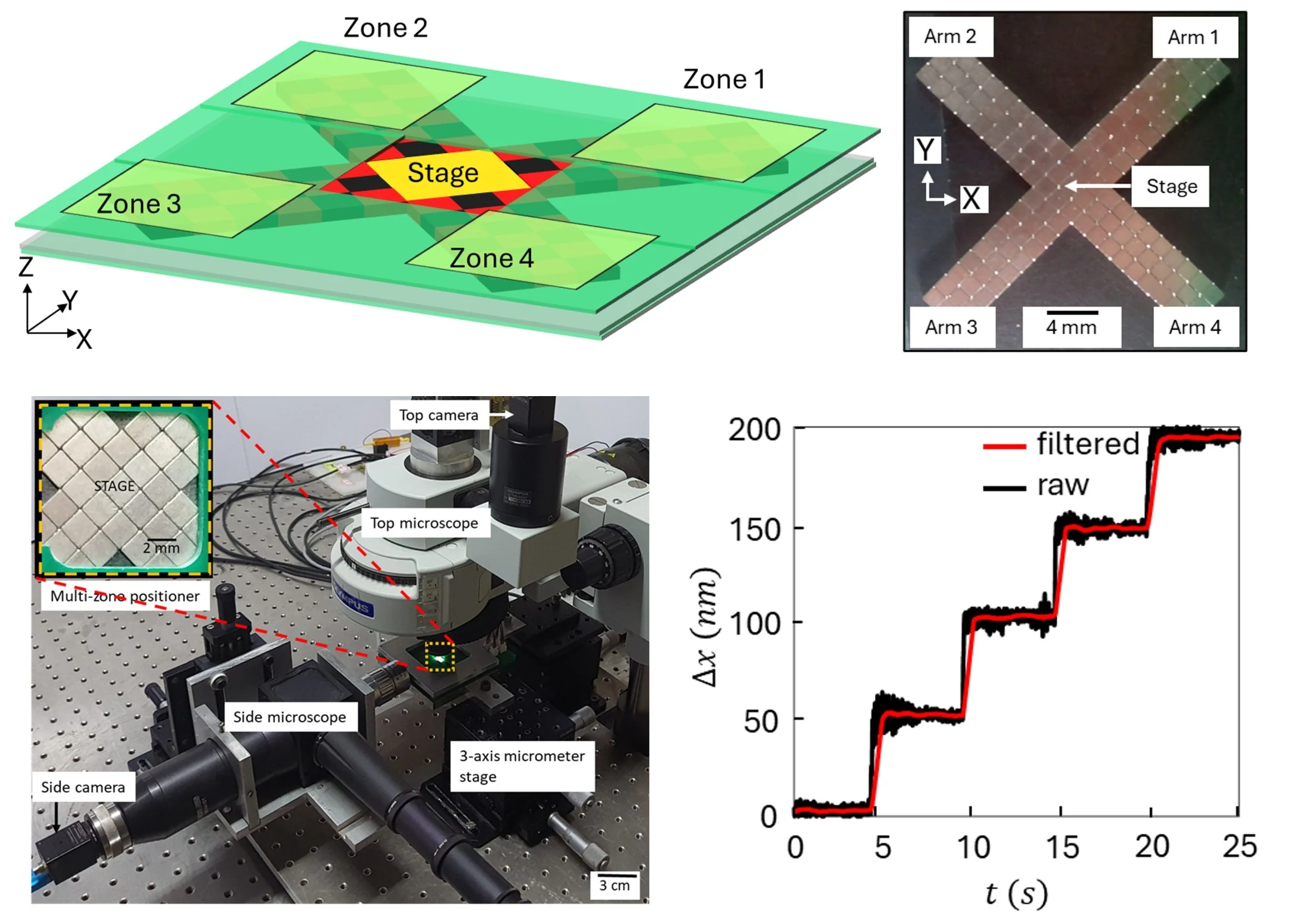
Multi-zone and compliant-stage configurations subsequently enabled large-range motion along all six degrees of freedom. The stages achieved 5 mm linear travel with positioning precision better than 1.88 nm, approximately 1.1 rad angular travel with 50 µrad resolution, and compact volumes of approximately 10–20 cm³.
Why the work mattered
In a single-sided system, increasing lateral trapping current also increases downward electromagnetic force. This reduces levitation height and eventually causes contact with the diamagnetic substrate. The dual-sided architecture cancels undesirable out-of-plane force while reinforcing useful in-plane forces and stiffness.
Technical approach
- Passive diamagnetic levitation
- Symmetric upper and lower PCB actuation
- Multi-zone force and torque generation
- Current-based force, torque, and stiffness allocation
- Top- and side-view optical measurement
- Subpixel digital image correlation and real-time multi-axis commands
Selected results
Research leadership and contribution
Dr. Singh led the experimental and system-level development of the diamagnetically levitated nanopositioners. Building on Prof. G. R. Jayanth’s initial research direction, he identified the force-coupling and vibration limitations of single-sided actuation and proposed the symmetric dual-PCB architecture used to overcome them. He performed the initial electromagnetic simulations, developed and integrated the positioning stages, implemented the real-time multi-axis actuation and image-based measurement systems, and conducted the complete experimental characterization and AFM tip-replacement demonstration. The analytical framework and manuscript were developed jointly with Prof. Jayanth, with Ms. Pranali Gaydhane contributing to the subpixel position-measurement code.
Demonstration
Six-axis diamagnetic motion
Large-range translational and rotational movement of the diamagnetically levitated stage. The silent video is shown from the completed doctoral research at IISc Bangalore.
Connection to current PIC Lab research
This work established foundations in passive levitation, compact six-axis actuation, current-based load allocation, machine-vision metrology, and instrument-integrated precision control. It directly motivates the current Contactless Multi-Axis Precision Positioning program.
Publication and intellectual property
K. S. Vikrant and G. R. Jayanth, “Diamagnetically Levitated Nanopositioners with Large-Range and Multiple Degrees of Freedom,” Nature Communications, 13, 3334, 2022.
Recognition: Nature Communications Editors’ Highlight.
Related IP: Indian Patent No. 538904, “Positioning of Payloads.”