Project overview
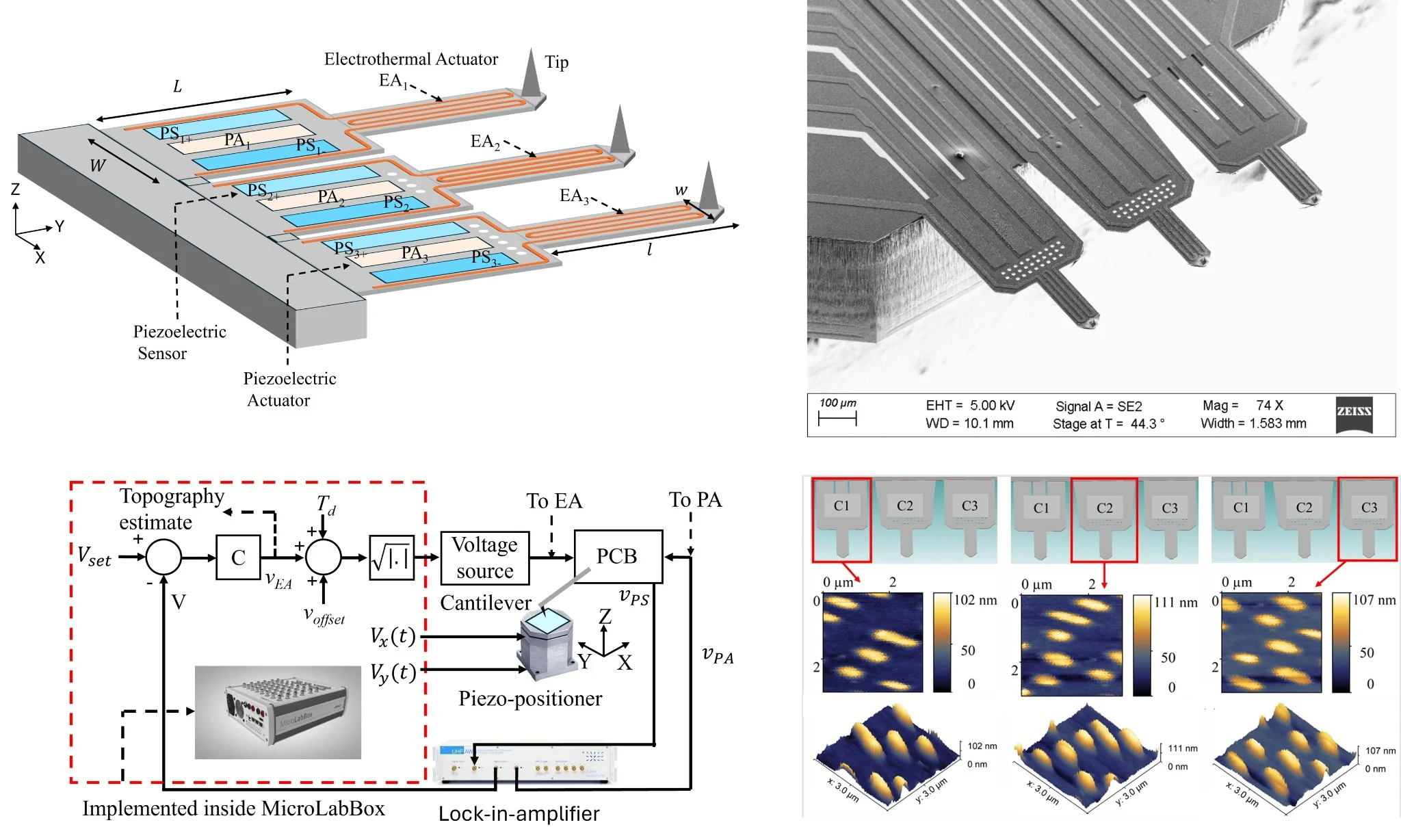
This project developed a compact parallel AFM architecture based on an array of three active MEMS microcantilevers. Each cantilever integrates a piezoelectric actuator for high-frequency tapping, differential piezoelectric sensors for self-sensing, and a large-range electrothermal actuator for closed-loop regulation of tip–sample separation.
All three probes were operated simultaneously using independent feedback loops and an in-house-developed AFM platform.
Why the work mattered
Conventional parallel AFM implementations replicate macroscale scan heads, actuators, optical sensors, and alignment hardware. This increases mass, footprint, vibration sensitivity, and calibration effort. Integrated active probes reduce the size of each head and remove several external components.
Technical approach
- Three-cantilever MEMS array
- Integrated piezoelectric actuation and differential sensing
- Integrated electrothermal Z actuation
- Actuator and sensor calibration
- Mechanical and electrical cross-talk characterization
- In-house AFM platform and three real-time feedback loops
- Simultaneous topography acquisition and image stitching
Selected results
Research leadership and contribution
Dr. Singh made major contributions to the experimental realization and completion of the parallel AFM platform. Working with Dr. Hazhir Mahmoodi Nasrabadi, he co-developed the in-house AFM setup, calibrated the integrated actuators and sensors, implemented the closed-loop imaging system, and conducted the parallel AFM experiments. Under the guidance of Prof. S. O. Reza Moheimani, he also developed several of the system models, equations, and technical schematics, substantially rewrote the journal manuscript, and led the response to most reviewer comments. The research concept and supervision were provided by Prof. Moheimani, while Dr. Nasrabadi led the design and fabrication of the active cantilever array.
Connection to current PIC Lab research
This project provides the immediate experimental foundation for the current Parallel Atomic Force Microscopy program. The new program extends the demonstrated three-probe operation toward architectures in which more actuation, sensing, electronics, and data-processing resources can be shared.
Publications
H. M. Nasrabadi, K. S. Vikrant, and S. O. R. Moheimani, “Parallel Active Microcantilevers for High-Throughput Atomic Force Microscopy,” IEEE/ASME Transactions on Mechatronics, accepted 2026; final pagination pending.
Precursor journal work: “Integration of Piezoelectric and Electrothermal Actuators for High-Resolution Atomic Force Microscopy,” Mechatronics, 99, 103165, 2024.