Project overview
This project established analytical design rules for improving the force density, trapping stiffness, and achievable bandwidth of planar electromagnetic actuators used in levitated precision stages and untethered micro-robotic systems.
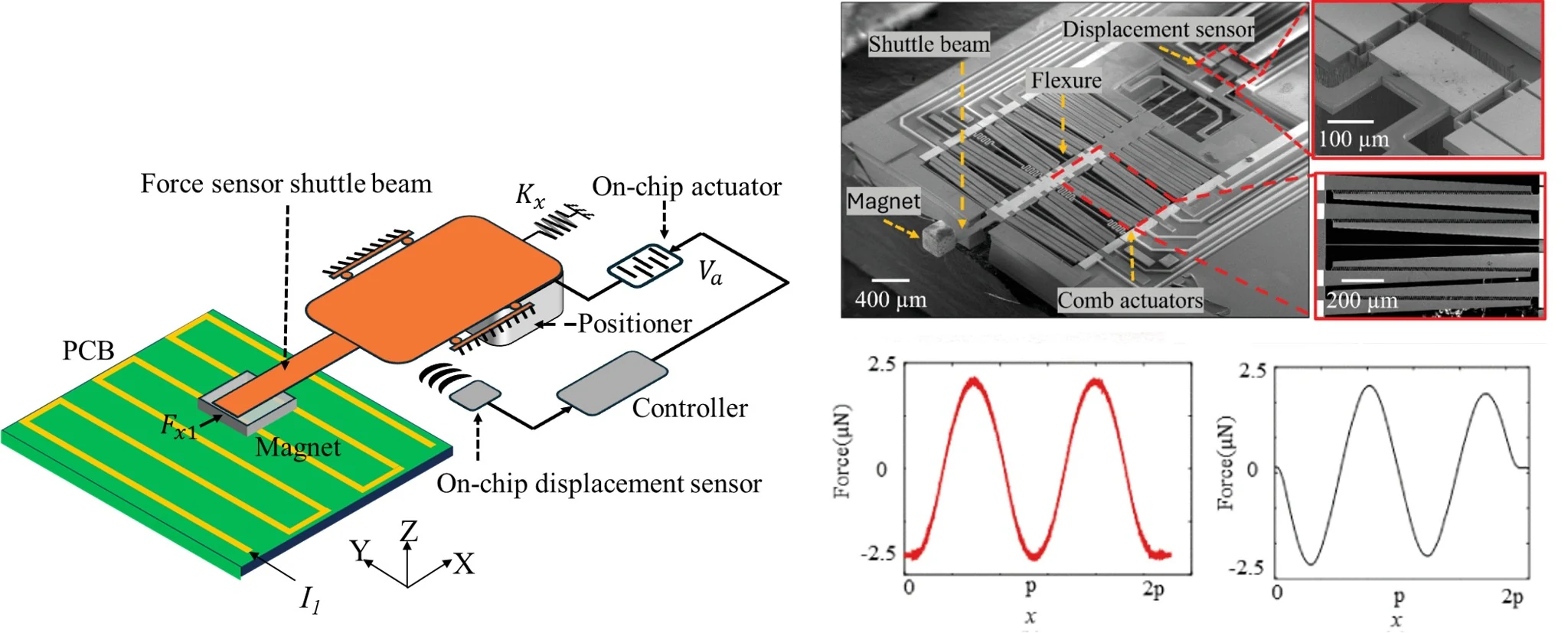
Closed-form expressions connected actuator performance with coil pitch, conductor geometry, magnet dimensions, magnet position, magnetization, and current. A custom MATLAB numerical model and a feedback-controlled MEMS force sensor were used for validation.
Why the work mattered
The natural frequency and realistic closed-loop bandwidth of a levitated electromagnetic platform depend strongly on trapping stiffness relative to moving mass. Optimizing absolute force alone is insufficient; the relevant metrics are force and stiffness per unit moving volume.
Technical approach
- Closed-form electromagnetic field, force, and stiffness derivation
- Optimization of magnet dimensions, coil pitch, and separation
- Magnetic-array scaling strategies
- Custom MATLAB-based numerical verification
- Feedback-controlled MEMS force measurement
- Experimental comparison across geometries
Selected results
Research leadership and contribution
Dr. Singh independently conceived and led the analytical, numerical, and experimental development of this project during his postdoctoral research. Building on earlier electromagnetic modeling developed with Prof. G. R. Jayanth, he derived complete closed-form design relationships for planar electromagnetic actuators, identified geometries that maximize force and trapping stiffness per unit volume, developed the MATLAB-based numerical model, and designed and conducted the experimental validation using a MEMS force sensor. Diyako Dadkhah assisted with force-sensor operation and measurements, and Prof. S. O. Reza Moheimani provided guidance and supervision.
Connections to current PIC Lab research
The scaling laws support higher-stiffness electromagnetic traps for contactless positioning. Miniaturized high-stiffness actuators may support replicated probe systems for parallel AFM, while the feedback force-measurement framework informs calibrated mechanical stimulation in mechanobiology.
Publication
K. S. Vikrant, D. Dadkhah, and S. O. R. Moheimani, “Optimization of Design Parameters to Improve Performance of a Planar Electromagnetic Actuator,” IEEE Transactions on Magnetics, 60(9), 8000610, 2024.