The research challenge
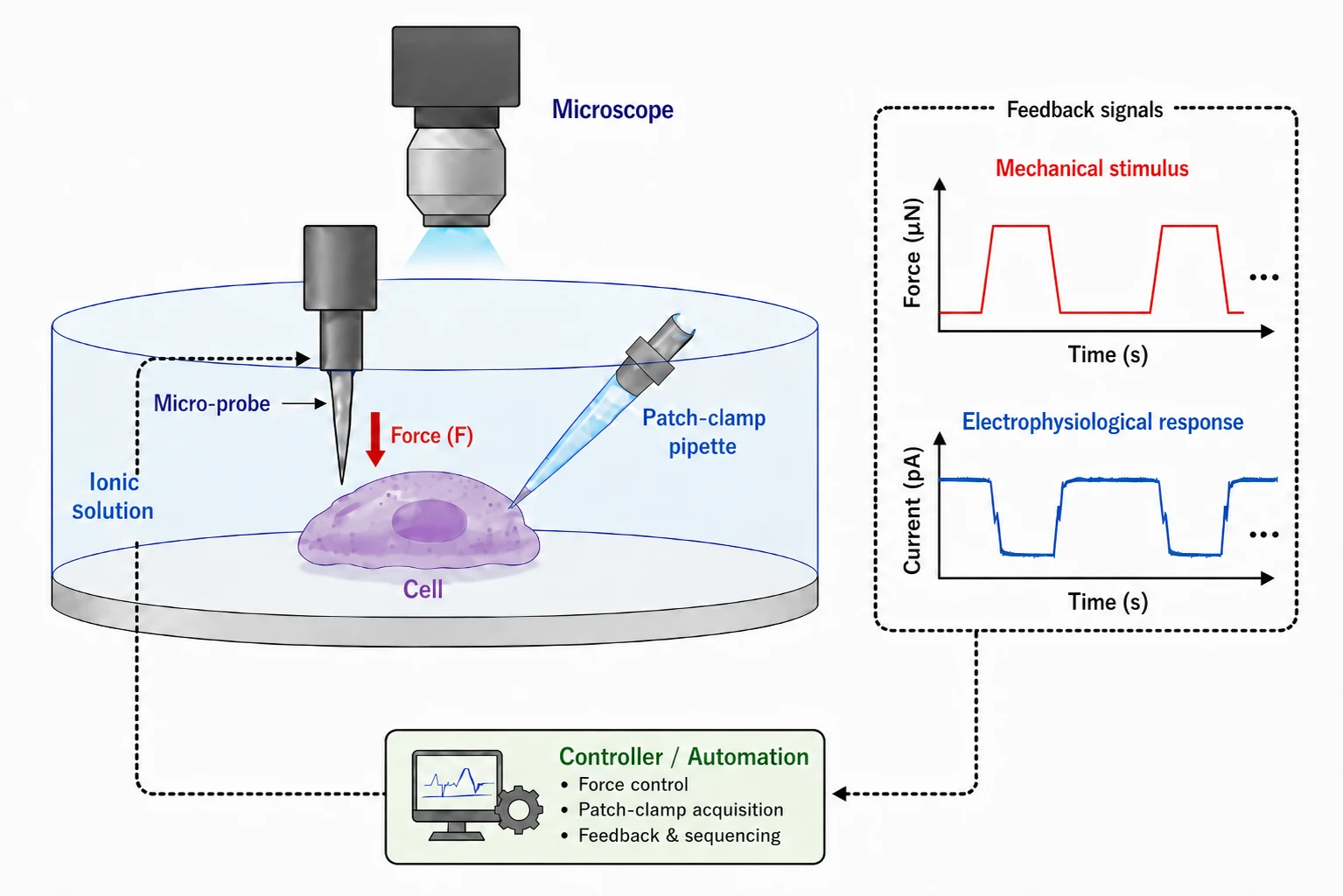
Single-cell patch clamp combined with mechanical stimulation is a powerful approach for studying sensory neurons. Existing experiments, however, often lack an instrument that can simultaneously apply a calibrated mechanical input and measure the associated mechanosensitive ion current under physiologically relevant conditions.
Many workflows are manual: a researcher locates a cell, positions a stimulation probe, establishes patch clamp, applies mechanical inputs, monitors force, and records the electrical response. This limits throughput and creates variability between experiments—an important bottleneck for heterogeneous human dorsal root ganglion neurons with limited post-isolation viability.
Our research direction
PIC Lab is developing an automation framework that integrates a micro-probe, force measurement and feedback, patch-clamp-compatible recording, optical microscopy, synchronized acquisition, and experiment sequencing.
The measured mechanical stimulus and electrophysiological current will be treated as coordinated feedback signals, enabling the applied input and cellular response to be acquired and controlled within one instrumentation framework.
Research questions
Calibrated forces in liquid
How can precise and repeatable forces be applied while minimizing fluid, surface, alignment, and probe–cell interaction artifacts?
Synchronized force and current
How can mechanical and electrophysiological signals be calibrated, time-aligned, and interpreted with compatible uncertainty?
Automated workflow
How can cell targeting, probe positioning, stimulus sequencing, data acquisition, and quality checks be automated to improve throughput and reproducibility?
Potential applications
Research collaboration
This direction builds on collaborative work with Prof. Theodore J. Price and Prof. S. O. Reza Moheimani at the University of Texas at Dallas. Previous experiments combined feedback-controlled MEMS force transducers with patch-clamp measurements involving human dorsal root ganglion neurons.
Research opportunities
Researchers may contribute to force sensing, micro-probe and micro-robotic instruments, control in liquid environments, microscopy, image-based automation, patch-clamp integration, synchronized acquisition, calibration, uncertainty analysis, and cell-mechanics experiments.
Foundations in previous work
The project extends prior work in MEMS force metrology, planar electromagnetic actuation, and collaborative mechanobiology experiments.