The research challenge
Atomic force microscopy provides exceptional nanoscale surface information by raster-scanning a sharp probe over a sample. Conventional AFM is fundamentally serial: one probe measures one point or line at a time. Imaging even a small region can therefore require several minutes, making large-area inspection and statistically meaningful sampling difficult.
Replicating conventional AFM heads increases the number of macroscale actuators, sensors, mechanics, and optical alignment channels. The central challenge is to increase the number of probes without proportionally increasing the mass, footprint, calibration effort, and complexity of the complete instrument.
Our research direction
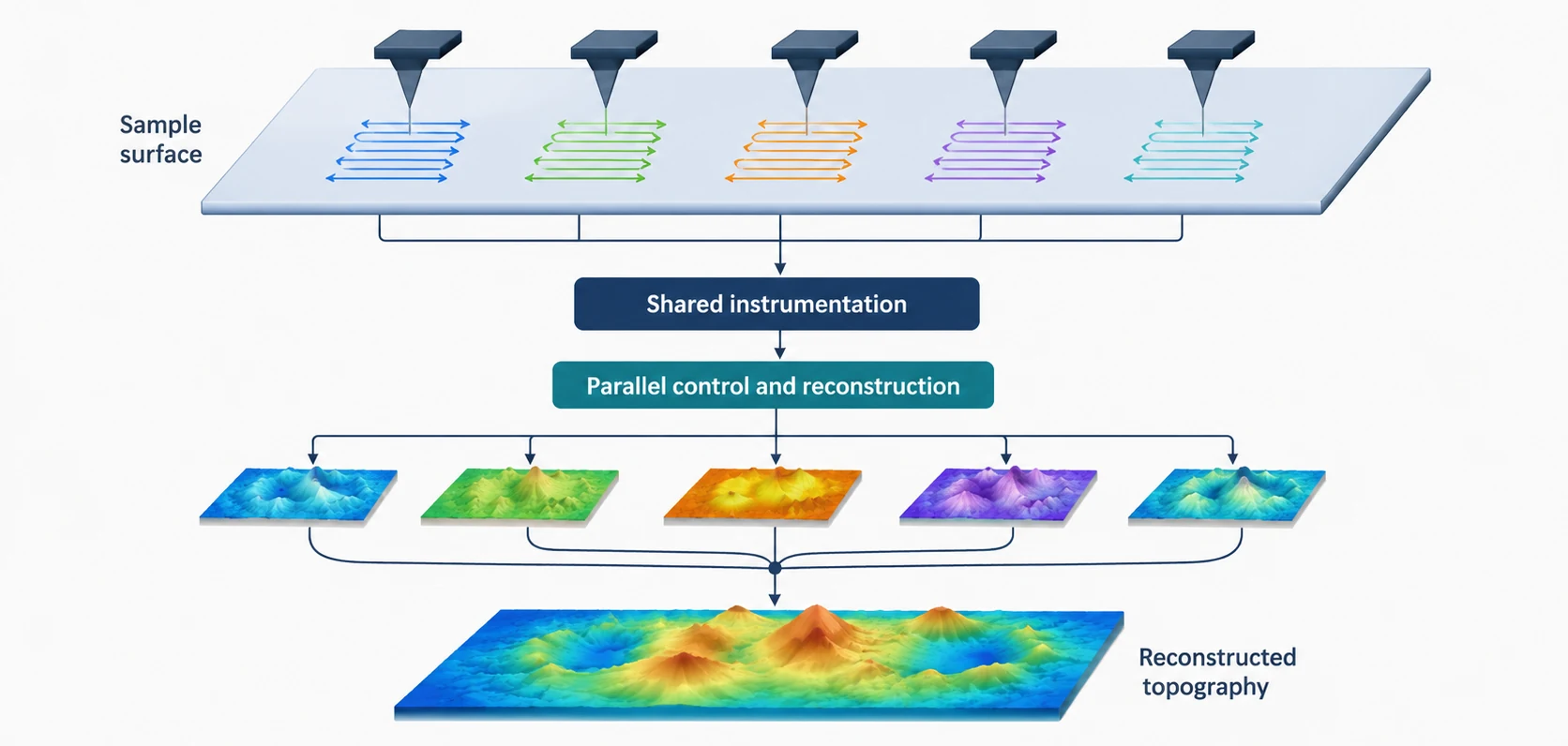
PIC Lab is exploring functional architectures built around four broad ideas:
- Multiple probes measuring distinct sample regions simultaneously
- Shared instrumentation wherever technically possible
- Independent but coordinated tip–sample interaction control
- Parallel reconstruction of local measurements into larger topography maps
The public schematic intentionally presents a functional architecture; the exact support, actuation, sensing, and control implementation will be developed within the research program.
Research questions
Parallel interaction control
How can several probes operate simultaneously without compromising the stability and accuracy of each tip–sample feedback loop?
Shared hardware
Which elements of actuation, sensing, signal conditioning, data acquisition, and real-time computing can be shared without increasing cross-talk?
Reliable reconstruction
How should probe variation, drift, spatial registration, calibration, and image stitching be handled to obtain accurate large-area topography?
Potential applications
Research opportunities
Researchers may work on probe dynamics, tip–sample interaction, MEMS and microsystem design, sensing electronics, multi-probe feedback, real-time computing, calibration, cross-talk reduction, image registration, topography reconstruction, and microfabrication.
Foundations in previous work
The immediate experimental foundation is the three-cantilever active MEMS AFM architecture developed at UT Dallas. Automated tip-replacement work at IISc provides a complementary foundation in machine-vision-guided probe handling and instrument maintenance.