The research challenge
Precision positioning is central to semiconductor inspection, optical metrology, device assembly, scanning instrumentation, and advanced packaging. These applications often require large travel, nanometre-class local resolution, high bandwidth, payload capacity, and motion along several translational and rotational degrees of freedom.
Conventional systems meet these requirements by combining motorized coarse stages with piezoelectric or flexure-guided fine stages and then stacking modules for multi-axis motion. Although mature, such architectures increase moving mass and footprint, lower structural resonances, and introduce parasitic coupling.
Our research direction
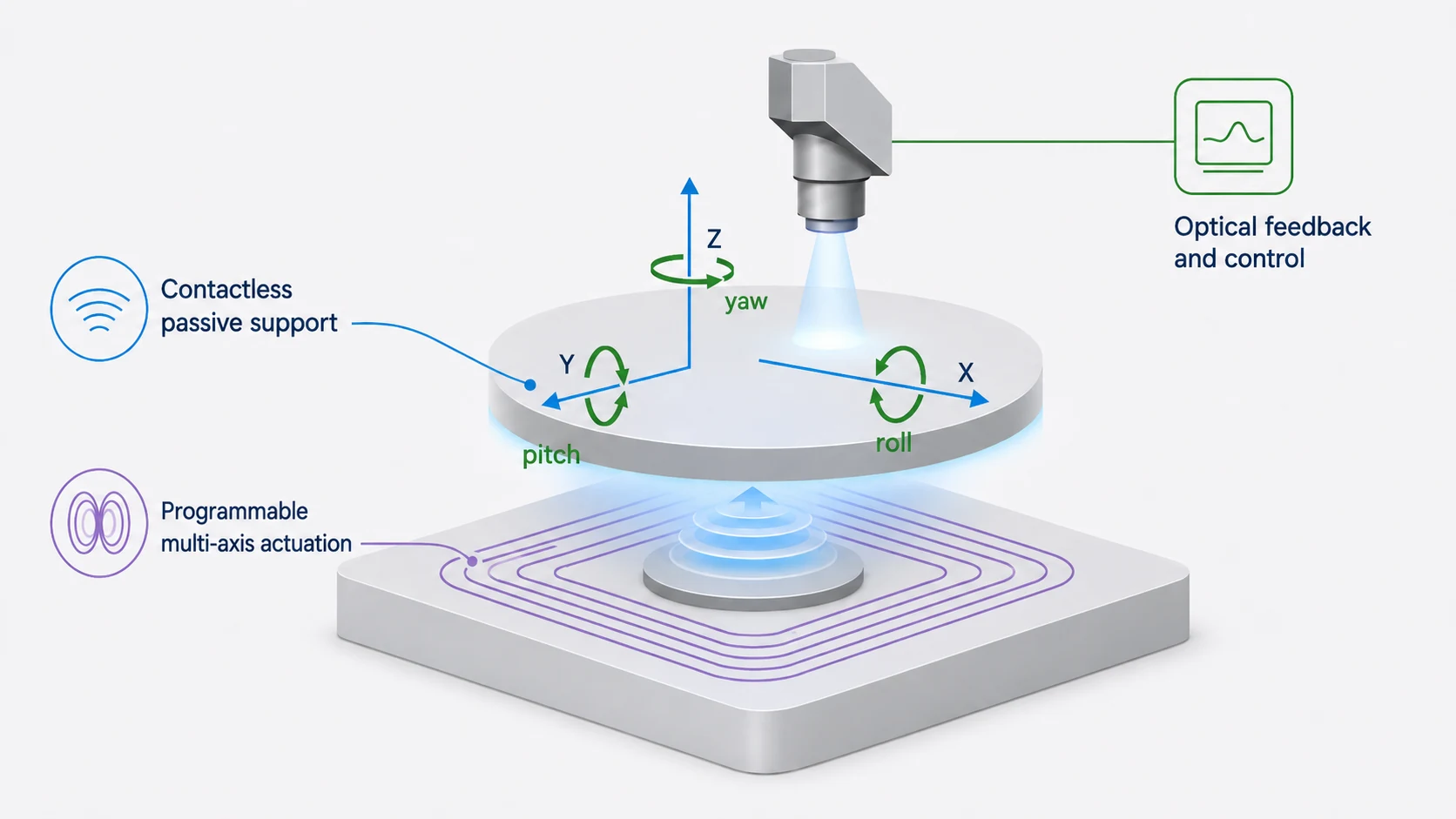
PIC Lab is investigating a contactless precision-positioning architecture that combines three functional layers:
- Contactless passive support
- Programmable multi-axis actuation
- Optical feedback and control
The central scientific question is how these layers can be co-designed to provide stable six-axis motion while retaining the compactness and integration advantages of passively supported systems.
Questions we are investigating
Complementary stability
How can passive support and programmable actuation be combined so that the platform remains stable while allowing independently commanded translational and rotational motion?
Instrument-grade optical feedback
How can microscope- and camera-based measurements support multi-axis calibration, drift suppression, vibration reduction, trajectory tracking, and uncertainty analysis?
Performance scaling
How should payload, workspace, bandwidth, resolution, footprint, thermal behavior, and integration complexity be traded for a target application?
Potential applications
Research opportunities
Researchers may contribute to dynamic and multiphysics modeling, finite-element analysis, actuator and sensor design, power electronics, machine-vision measurement, system identification, multi-axis estimation and control, embedded implementation, and experimental validation.
Foundations in previous work
This direction builds directly on the six-degree-of-freedom diamagnetic nanopositioner developed during Dr. Singh’s doctoral work and the hybrid near-field acoustic–electromagnetic positioner developed during his postdoctoral research.
Initial support
Establishment of the initial experimental platform is supported through an IIT Kharagpur Faculty Start-up Research Grant.